A redundant power supply server has two power supplies, so it keeps running when one fails. The protection holds only if each supply sits on its own power path and one supply alone can carry the full load.
This page covers the power path inside and around a dedicated server. For the wider hardware picture, see the dedicated server specs guide. Related pages cover the gpu dedicated server and the single socket vs dual socket server.
How a second supply keeps the server running
Critical rack servers generally carry two power supplies, according to Mirazon’s guide to redundant power configuration. The second unit does not add speed or capacity. It removes the power supply as a single point of failure. The sequence when a unit dies is short:
- One supply fails. The server keeps operating on the other, as Broadberry’s redundant rackmount server documentation describes.
- An alarm sounds. An audible alarm alerts the user to the failed unit, so the fault does not sit unnoticed until the second supply also fails.
- The surviving supply carries everything. Where each supply is fed from a separate chain, Contabo’s data center explainer says the server runs entirely on the remaining supply without interruption.
- The failed unit is swapped live. Redundant supplies are hot-swappable, so the replacement happens without powering the server off.
A hot-swap PSU is what turns the second supply into a repair path as well as a safety net. The server stays in service while the faulty module is replaced. The practical consequence of step three is that each supply must be able to carry the full server load by itself, which drives the sizing advice later on.
Load sharing and Hot Spare mode
Two supplies can split the work or take turns. Modern servers only pull the total power they need at any moment, and that load is either shared between the PSUs or drawn from one while the other waits on hot standby, as Mirazon notes. The behaviour is a firmware setting on many servers, and the two modes suit different priorities.
| Mode | What happens | Planning use |
|---|---|---|
| Redundant, Hot Spare disabled | Power is supplied equally from both supplies | Suits setups where wear and heat should be spread across both units |
| Hot Spare enabled | The active supply supports 100% of the load and runs at higher efficiency; the sleeping supply monitors the active unit’s output voltage and takes over on a drop | Suits setups where efficiency matters, provided the standby unit is trusted to wake in time |
These behaviours are described in a Spiceworks community thread quoting vendor documentation.
1+1 versus N+1 redundancy
1+1 describes the pair of supplies inside one server, while N+1 describes a design rule applied across a facility. They answer the same worry at different scales.
1+1 inside the server
When two identical supplies are installed, the server’s BIOS offers 1+1 or 2+0 configurations. In 1+1, one supply’s worth of capacity is enough to run the system and the second is the spare. That is why a server such as the Dell PowerEdge 2800, which holds up to two 930 W supplies, needs only one to run, with the second providing redundancy.
N+1 across the facility
Contabo explains that a Tier III data center requires at least one additional backup for every critical system. For a dedicated server customer, that means a 1+1 server only delivers its full benefit inside a facility that also applies the extra-unit rule to feeds, distribution and battery backup.
Sizing PSU wattage for a redundant pair
Size each supply to carry the whole server, not half of it. Because the survivor takes the entire load after a failure, a pair of supplies that only add up to the load gives no real protection. The same logic applies upstream: any server PSU wattage calculator gives you the load figure, and the redundancy design decides how much headroom that figure needs.
- Check each supply, not the sum. The 930 W Dell example shows the pattern: the rated capacity of one unit is what must cover the server, and the second is the spare.
- Test the failover case on the circuit. Mirazon gives an example of two 20 A PDUs each carrying 11 A. Each looks within its limit, but after a failover one PDU has to carry both loads and goes above 20 A.
- Leave circuit headroom. Datacenter circuits are normally loaded to around 75-80 percent of capacity, so a rated circuit is not a target.
- Expect higher-capacity racks. Mirazon notes a move towards 2x 30A 220V racks instead of 2x 20A 110V to give failover headroom.
- Revisit the figure when the build changes. A new accelerator plan for a gpu dedicated server, or a single socket vs dual socket server decision, alters what the surviving supply must carry.
Separate feeds, PDUs and UPS
Yes, the two supplies should connect to separate power feeds. Two supplies plugged into the same strip or the same UPS leave one shared component that can take both down at once. Mirazon names the pattern directly: both supplies on one uninterruptible power supply removes the redundancy you paid for.
What to separate
Mirazon’s recommended chain is two power supplies, two separate power distribution units, two separate UPS, and two feeds, with two carriers for network. Contabo describes the same idea in data center racks: each rack connects to two separate rack PDUs, and each PSU in a dual-PSU server connects to a different PDU drawing from a separate chain. When one chain fails, the other supply carries the server.
Where the PDU voltage comes from
Upstream, Contabo says PDUs step 480 V power down to either 400 V in modern facilities or 208 V in traditional ones. That is the facility’s job, but it explains why the two chains must stay independent right back to the source.
What the UPS adds
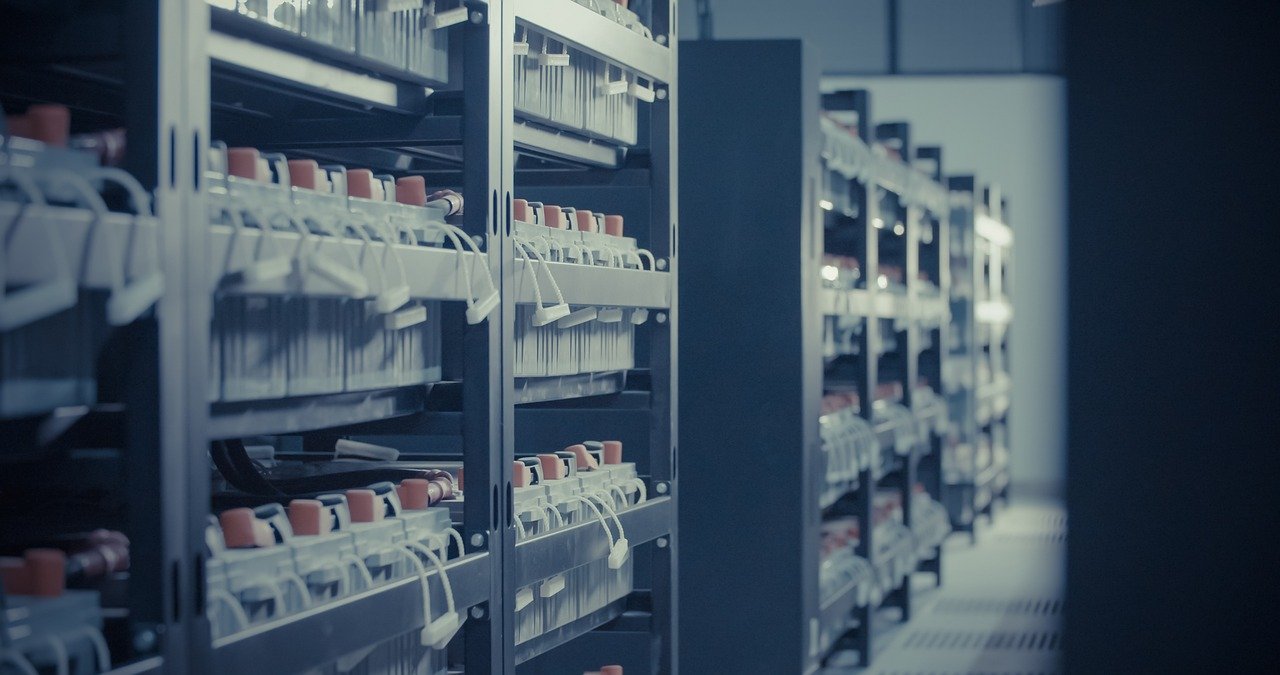
The UPS covers the gap between a utility problem and either a clean recovery or a generator. It is an upstream layer, not a substitute for the second PSU. A server with one supply behind a UPS still fails when that supply does.
When choosing hosting, ask whether the provider cables both supplies to different PDUs on different chains. Without that, a second PSU only protects against the supply failing, not against the feed failing.
Frequently asked questions
What voltage do server power supplies accept?
Contabo says modern servers typically have supplies that accept a range of 100-240 V, so the same unit works on different regional feeds.
How much downtime does a data center tier allow?
According to Contabo, Tier I offers 99.671% uptime, up to 28.8 hours of downtime yearly, while Tier III offers 99.982%, up to 1.6 hours of potential downtime yearly, with 72-hour power backup for extended outages.
What covers a power cut before the generators take over?
Contabo says some facilities use battery-based UPS systems providing up to 15 minutes of power, and generators reach full speed and stable output within 10-15 seconds.
Does a UPS shut the server down cleanly?
Not by itself. Mirazon notes that cleanly shutting down a server during a power failure requires applicable software installed on the server.